PRINCIPAL PARTNERS:

Anniversary Stories

One hundred years ago, a new era began at the Pfauen: the theatre became autonomous and artistically independent, underwent extensive renovations, and established itself as a permanent home for modern spoken theatre. Ever since, generations of artists, theatre-makers, and audiences have shaped this place.

To mark the anniversary, we set out in search of traces: of people and encounters, rituals and traditions, and the unconscious and unspoken elements that accompany a theatre across generations. Along the way, we hear from people with a special connection to Schauspielhaus Zürich and its history: contemporary witnesses and descendants, artists and companions, as well as authors and experts who have explored its past.

Together with them, we take a fresh look at the familiar and the lesser-known, at personal memories and historical contexts. Join us in discovering stories that have shaped Schauspielhaus Zürich – stories waiting to be retold and rediscovered.

01.10.2026 A BOUQUET OF FLOWERS AGAINST THE DICTATORSHIP

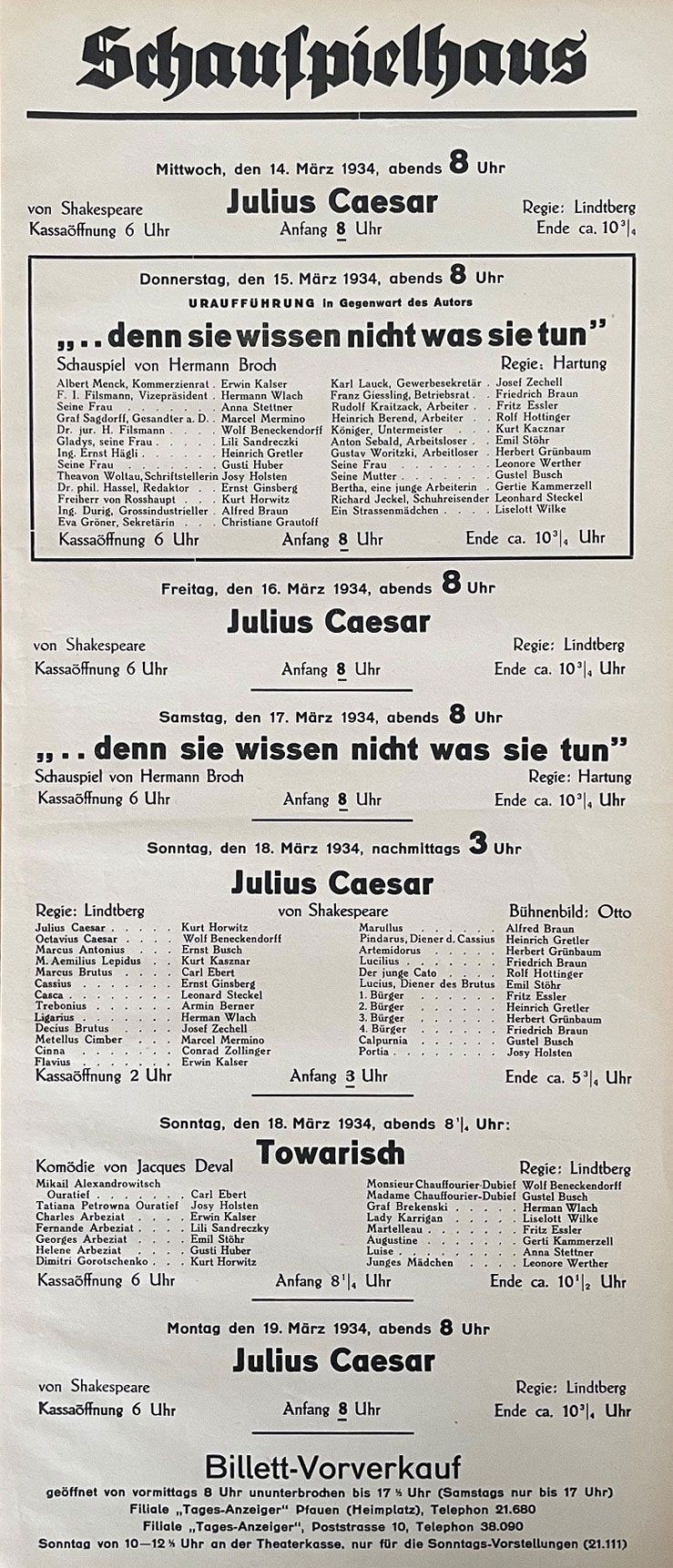
In the history of every German-language theatre, the 1933/34 season holds a unique place. With hindsight, we are all too aware of the devastating consequences of those years, prompting us to ask how the political upheaval was reflected in theatre programmes at the time. For theatres outside the German Reich in particular, a pressing question arose: how could they respond artistically to fascism taking hold just across the border?

The Schauspielhaus Zürich offers a striking example. Let us take a closer look at the productions staged there during that season.

THE 1933/34 SEASON AT SCHAUSPIELHAUS ZÜRICH

During the 1933/34 season, Schauspielhaus Zürich presented its audiences with a diverse spectrum of modern political thought. The programme brought together left-wing, liberal and bourgeois perspectives, creating, through their very juxtaposition, an exceptionally powerful antifascist and political statement.

The programme was shaped in part by theatre practitioners who had been forced to leave Germany and who found in Zurich the freedom to bring their sometimes very different artistic and political positions to the stage. Under the leadership of Zurich director Ferdinand Rieser, theatre artists including Kurt Hirschfeld, Leopold Lindtberg, Teo Otto and Gustav Hartung found refuge at Schauspielhaus Zürich after fleeing Nazi persecution because of their Jewish background and/or political convictions.

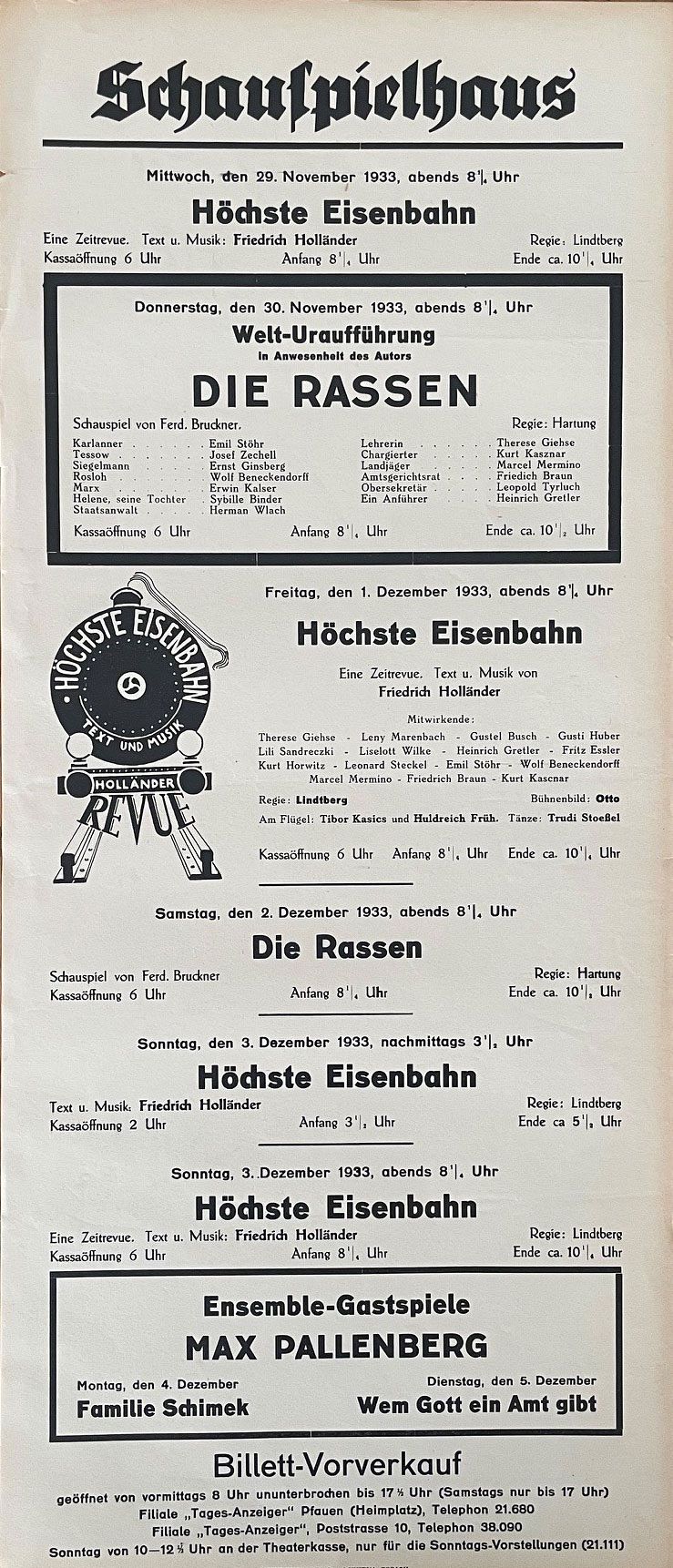
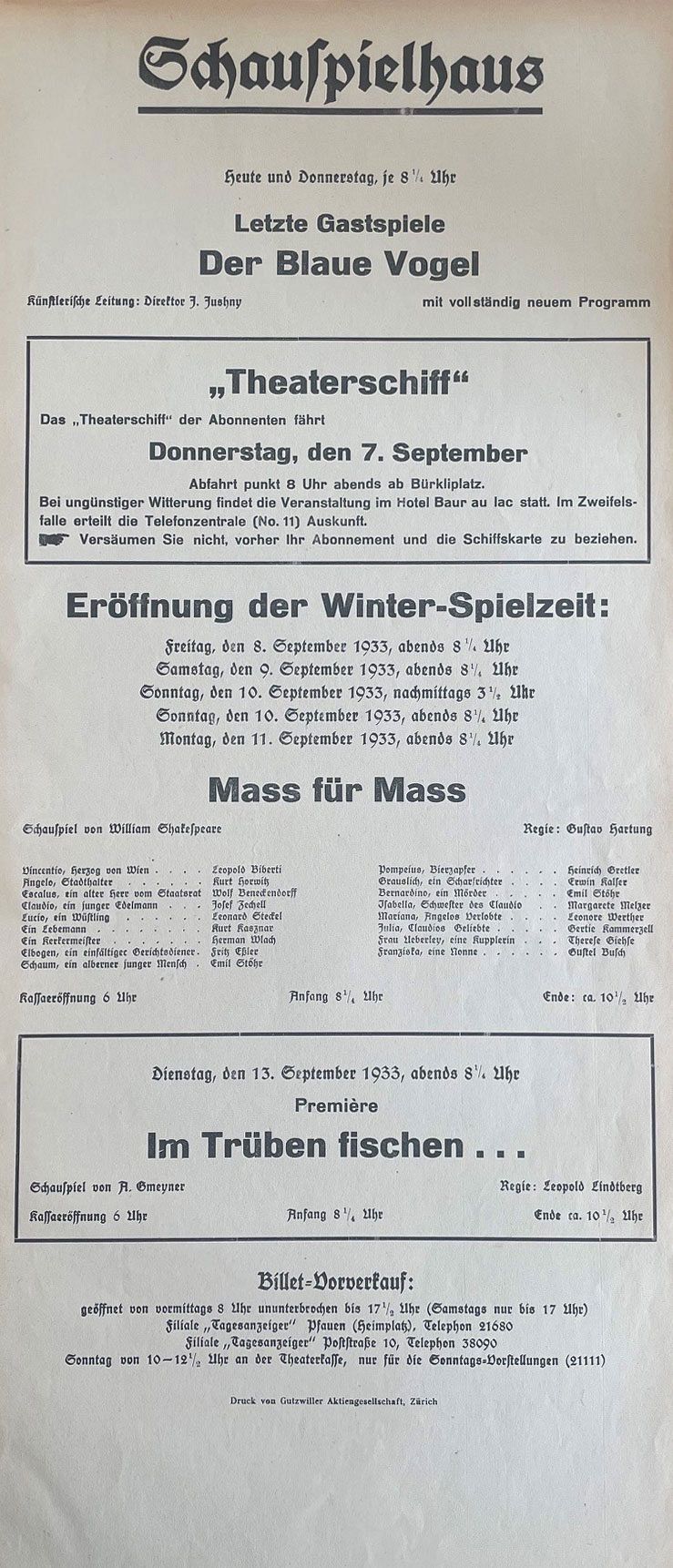
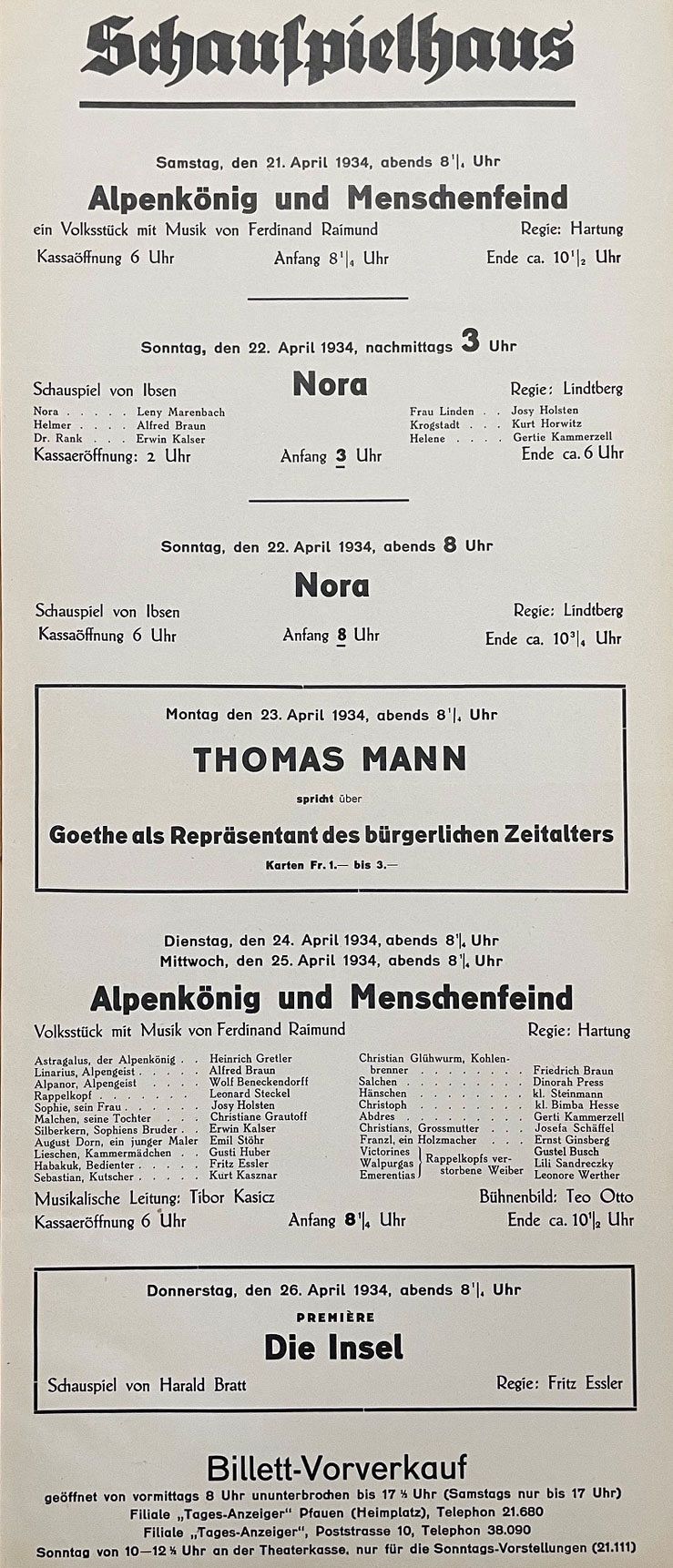
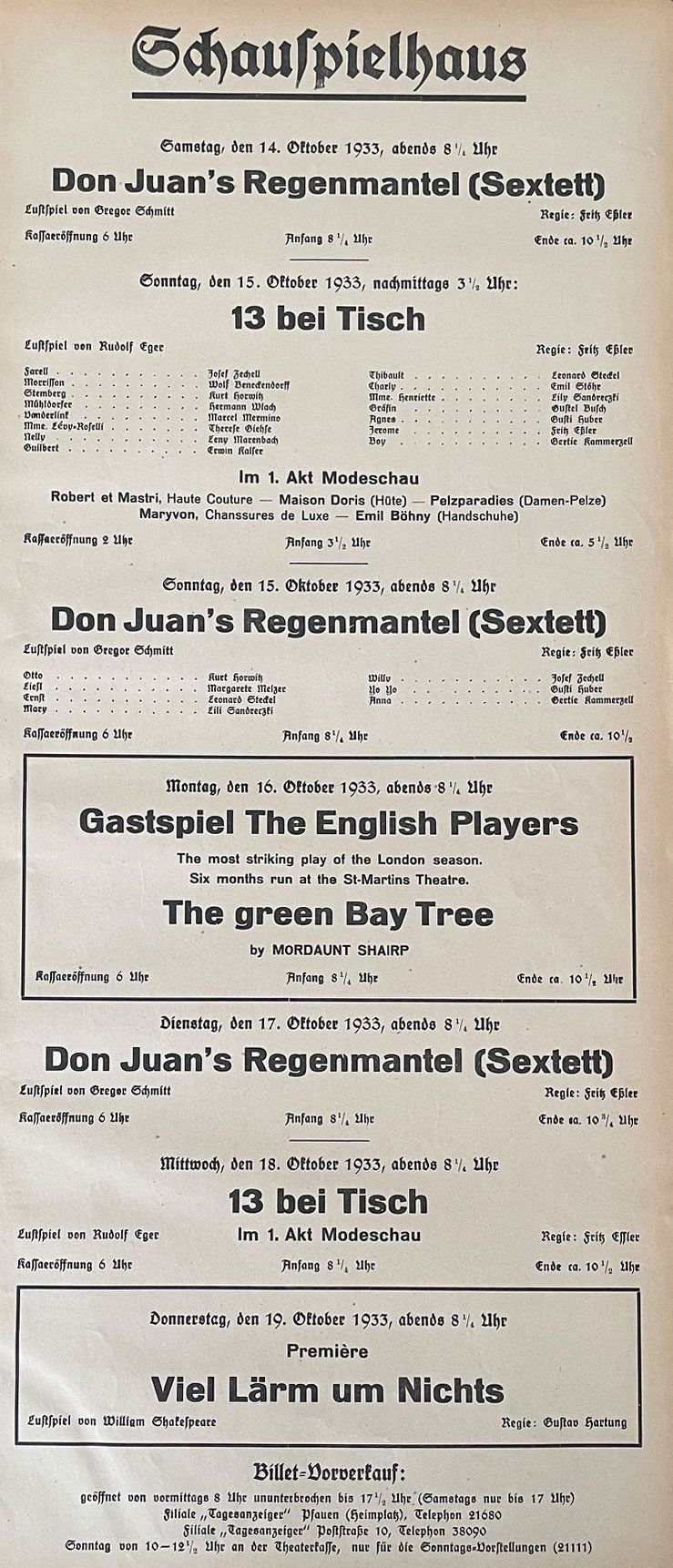
Together, they assembled a remarkably varied programme in Zurich: socially critical theatre by Ferdinand Bruckner, plays by Franz Werfel, a fashion show featuring plenty of fur, a “Theatre Ship”, a lecture by Thomas Mann, Kleist’s The Broken Jug, Molière, no fewer than four works by Shakespeare, a guest performance from England, spoken drama by Ibsen, and cabaret-style musical theatre by the composer Friedrich Holländer.

Under Rieser, artistic freedom and pluralism were paramount. And this was by no means limited to classical drama: all forms of performing arts threatened by fascism were welcome in Zurich – whether “high” or “low” culture, entertaining or serious.

FASCISM IN FOCUS

Yet this diverse programme was political not only as a whole, but also in many of its details. In 1932, Friedrich Holländer’s Höchste Eisenbahn – a topical revue with text and music – was still being performed in Berlin. The work offered a satirical assessment of the chaotic conditions at the end of the Weimar Republic. Using the metaphor of a speeding train, Holländer portrayed a society hurtling towards the abyss of National Socialist dictatorship. In 1933, both the work and its author were forced to flee: while Holländer emigrated to the United States via Paris, Höchste Eisenbahn made its way to Switzerland. At Schauspielhaus Zürich, the piece could once again be staged, directed by fellow émigré Leopold Lindtberg. Reality had, of course, rapidly overtaken fiction – Hitler was Reich Chancellor, the press had been brought into line, the opposition silenced, and the German Reich had withdrawn from the League of Nations – yet the message of this production could hardly have been more timely: We will not submit to your censorship!

The true beacon of the Rieser era – and indeed of the entire German-language theatre world that remained free that year – was, however, a world premiere. On 30 November 1933, Gustav Hartung staged Die Rassen (The Races) by Austrian playwright Ferdinand Bruckner. The play depicts how a young student elite is swept up by Nazi ideology, racism and antisemitism, opportunistically falls into line, and ultimately takes an active part in the boycotts and persecution of Jews. Both the director and many members of the ensemble – among them Therese Giehse – had fled Germany. With Die Rassen, the Pfauen stage thus presented not only a fierce critique of National Socialism, but also those who had themselves been persecuted by the regime.

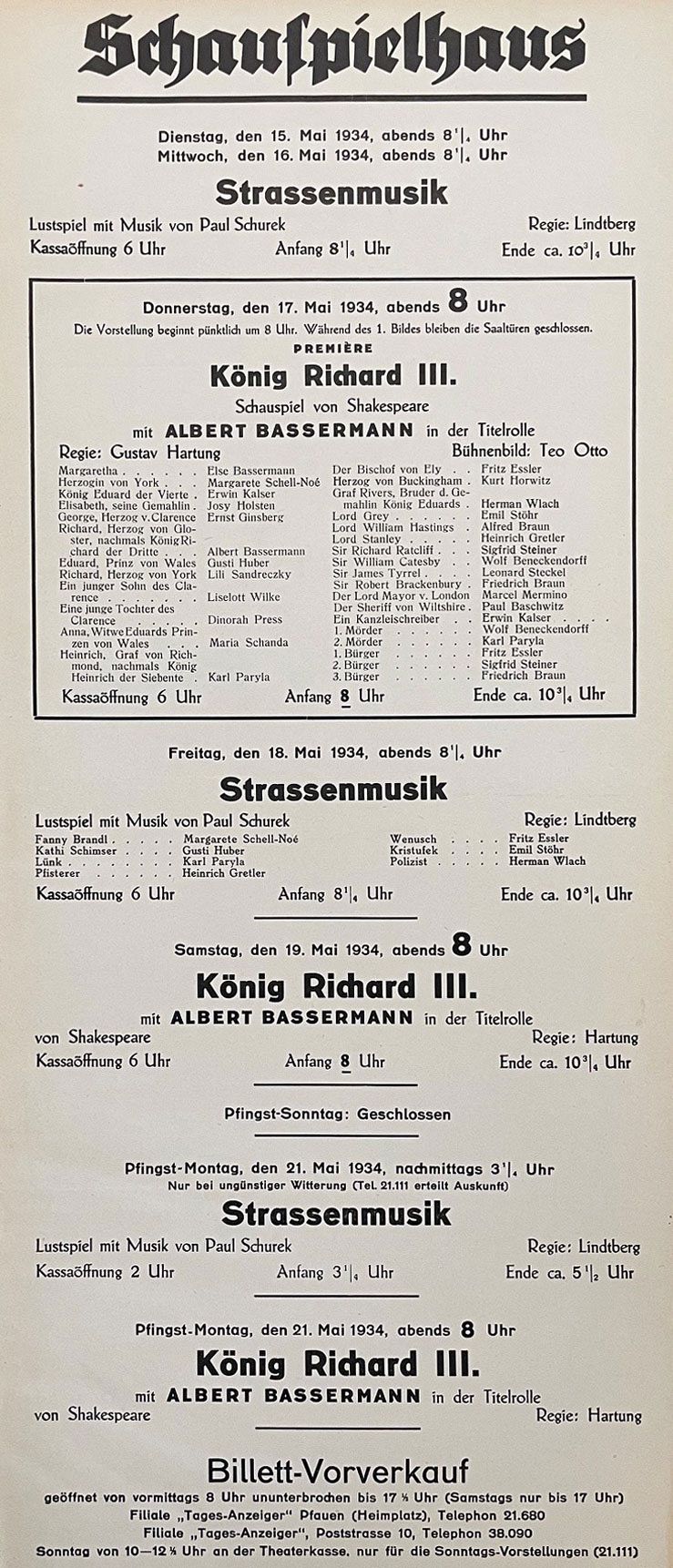
Throughout the 1933/34 season, Schauspielhaus Zürich repeatedly took a stand against the Nazi regime with courageous productions. In particular, Nazi antisemitism and anti-liberalism were challenged from a wide range of perspectives: whether through classics such as Julius Caesar or Richard III, which exposed the mechanisms of demagoguery and totalitarianism, or through modern drama such as Ibsen’s A Doll’s House, which countered the National Socialist ideal of women as mothers with a liberal vision of womanhood.

During this dramatic season, the Pfauen theatre thus became far more than a stage: it was a place of intellectual resistance, a refuge for those facing persecution, and a powerful symbol of artistic freedom.

24.09.2026 THE PHOTOGRAPHER BEHIND THE IMAGES: LEONARD ZUBLER

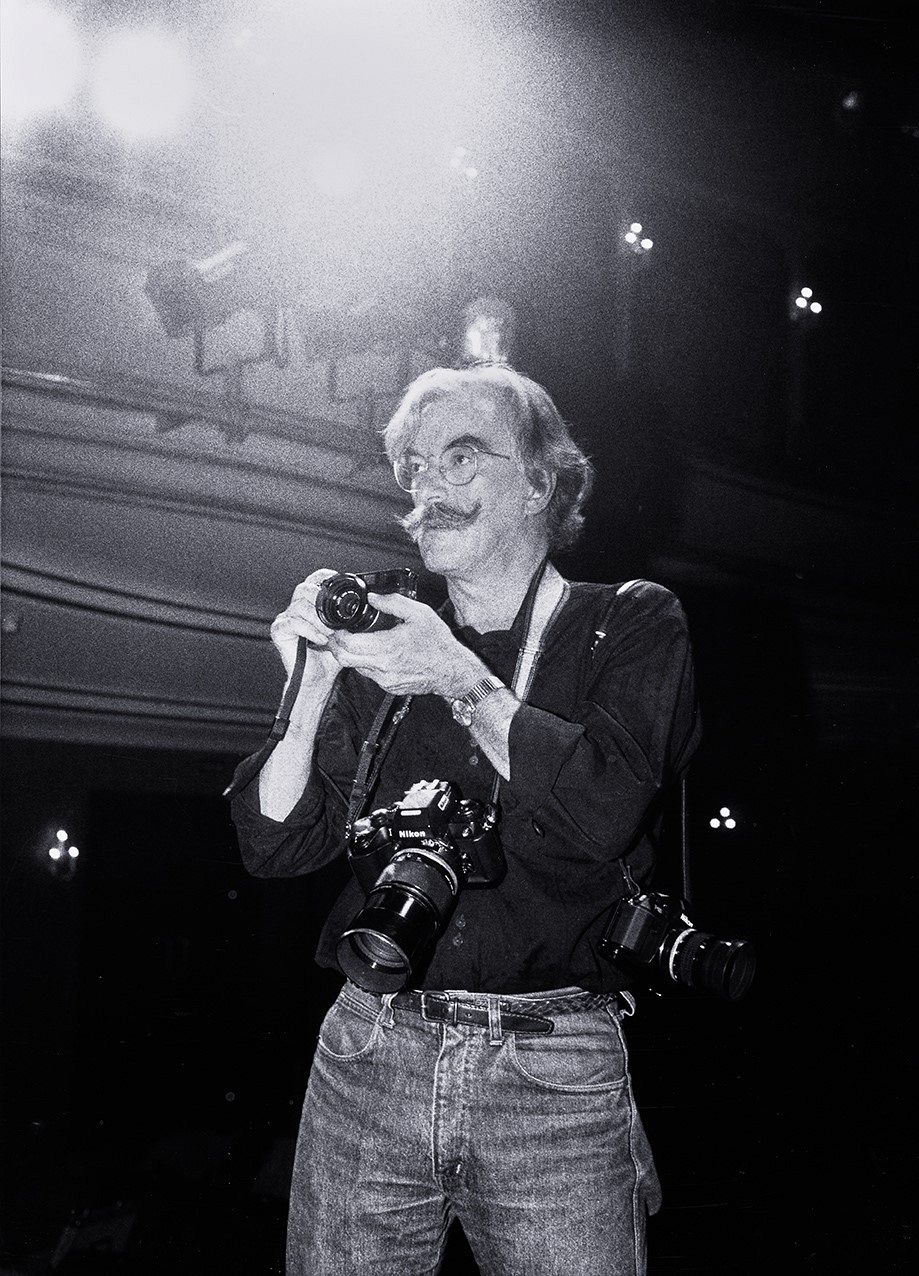
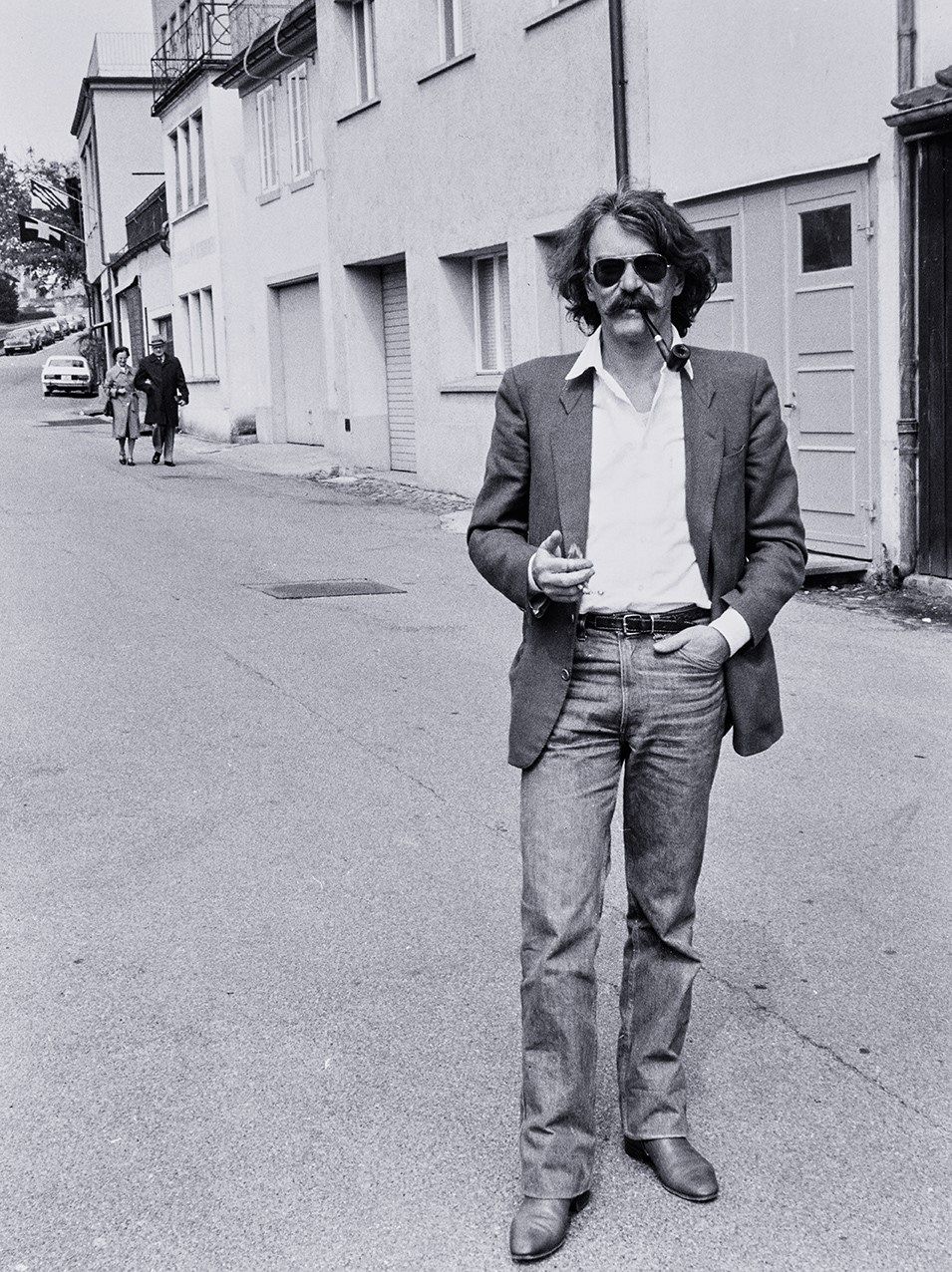
Leonard Zubler at the Pfauen in the 1990s © Raphael Zubler

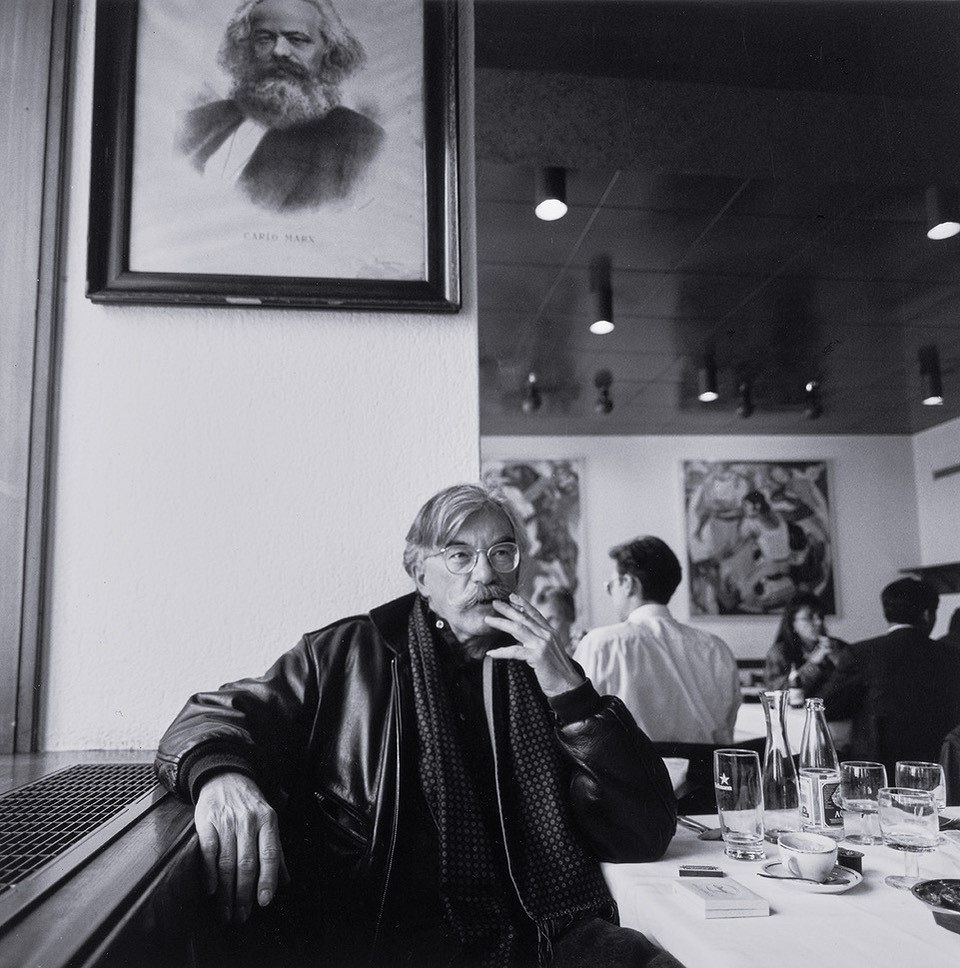
Leonard Zubler in Zurich in the 1990s © Raphael Zubler

Leonard Zubler in Bern in the 1980s © Zubler Archive

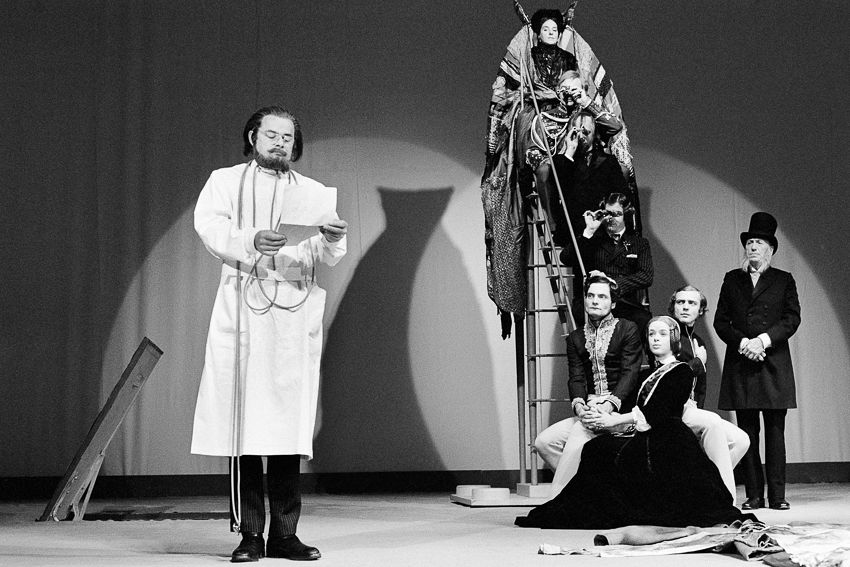
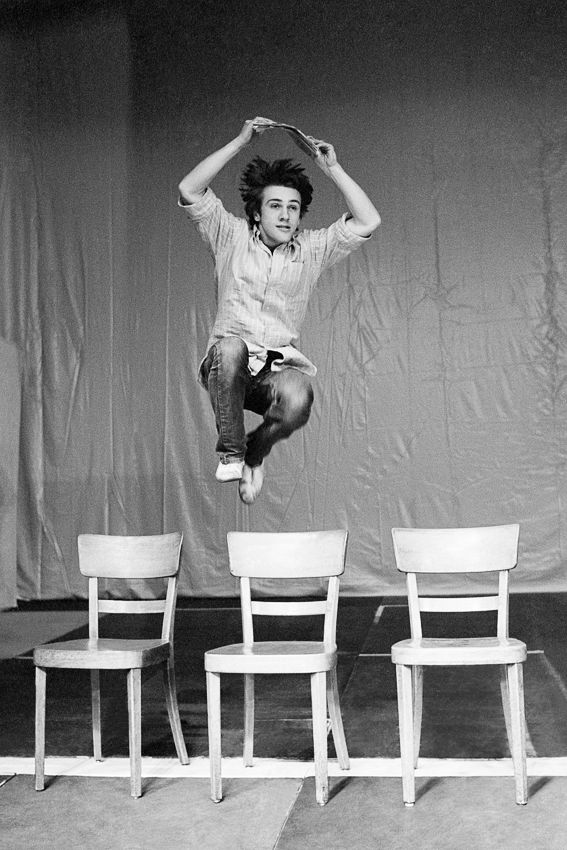
“Early Morning” (1969/70), by Edward Bond, directed by Peter Stein
© Leonard Zubler

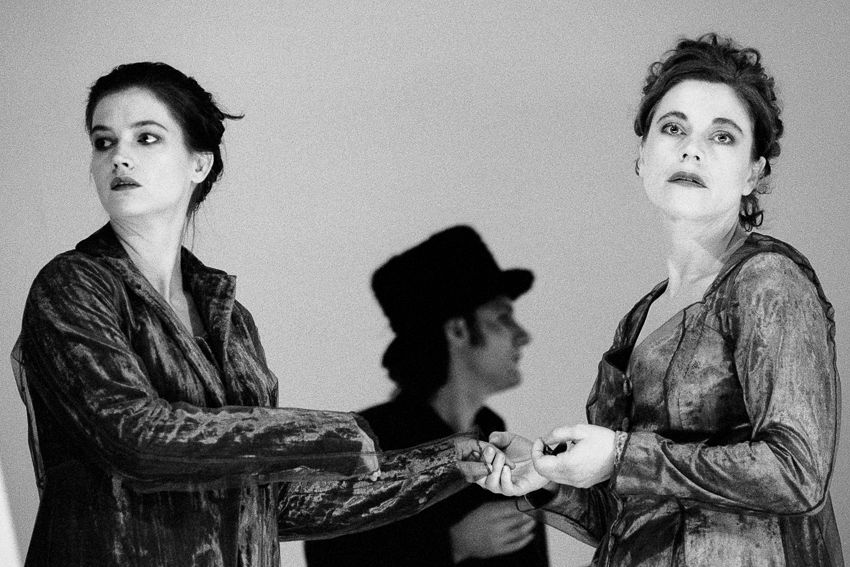
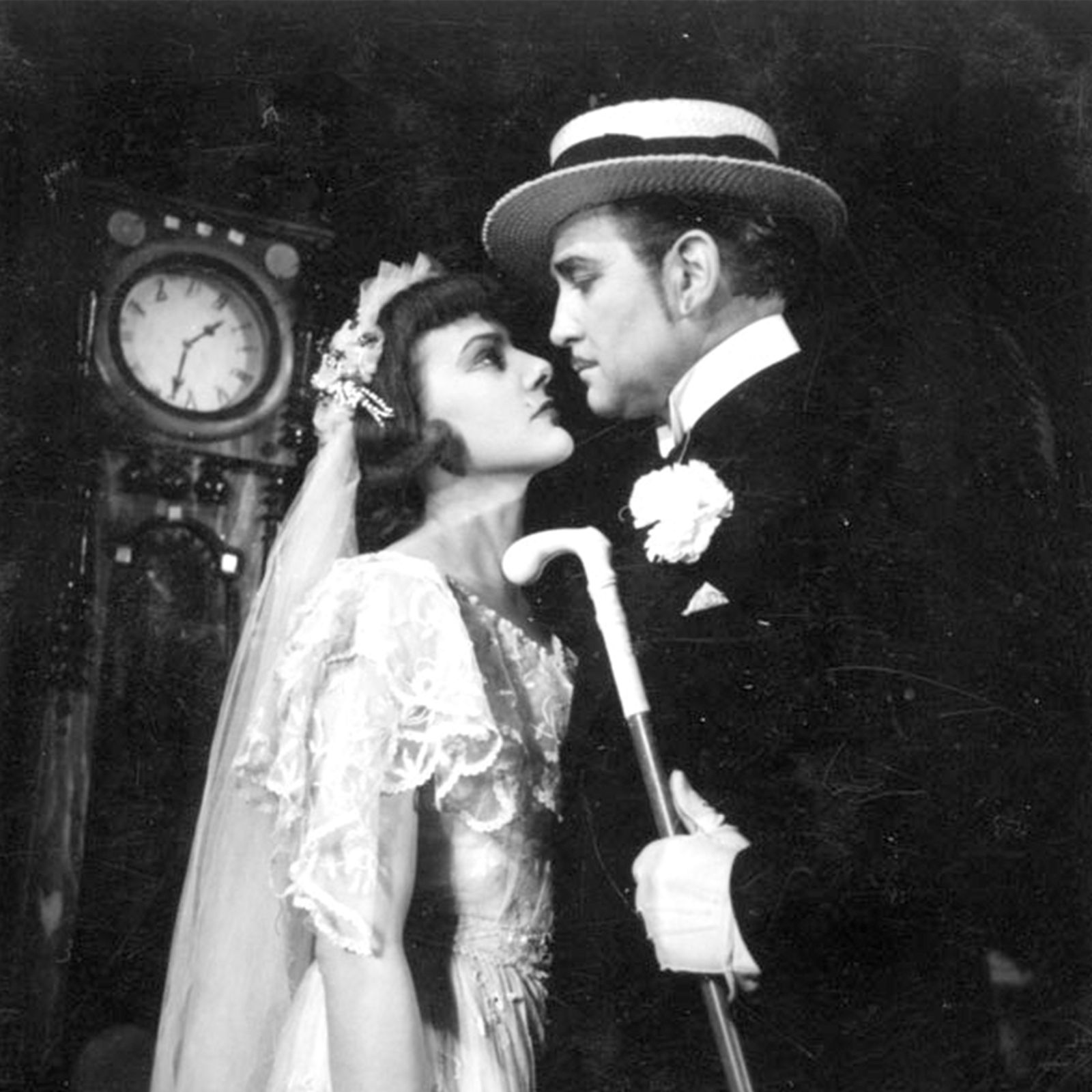
“The Kiss of Oblivion” (1998/99), by Botho Strauss, directed by Matthias Hartmann
© Leonard Zubler

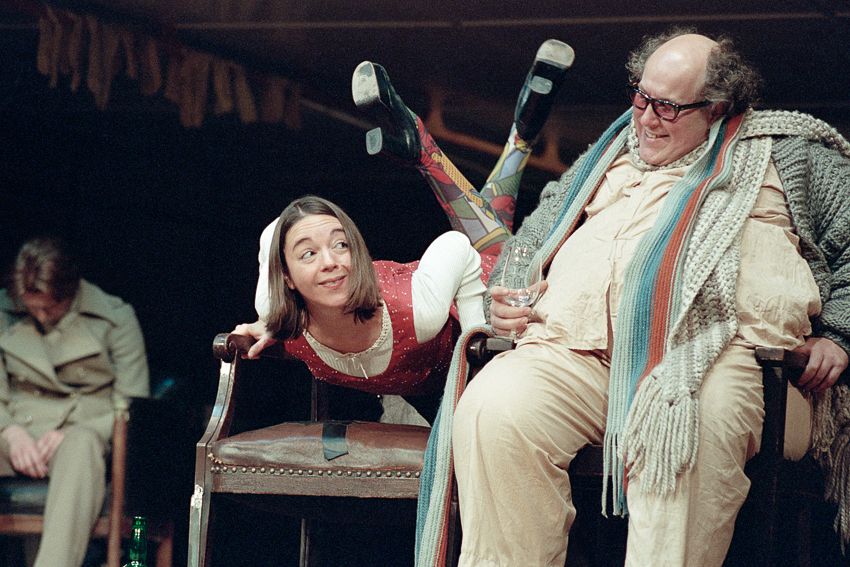
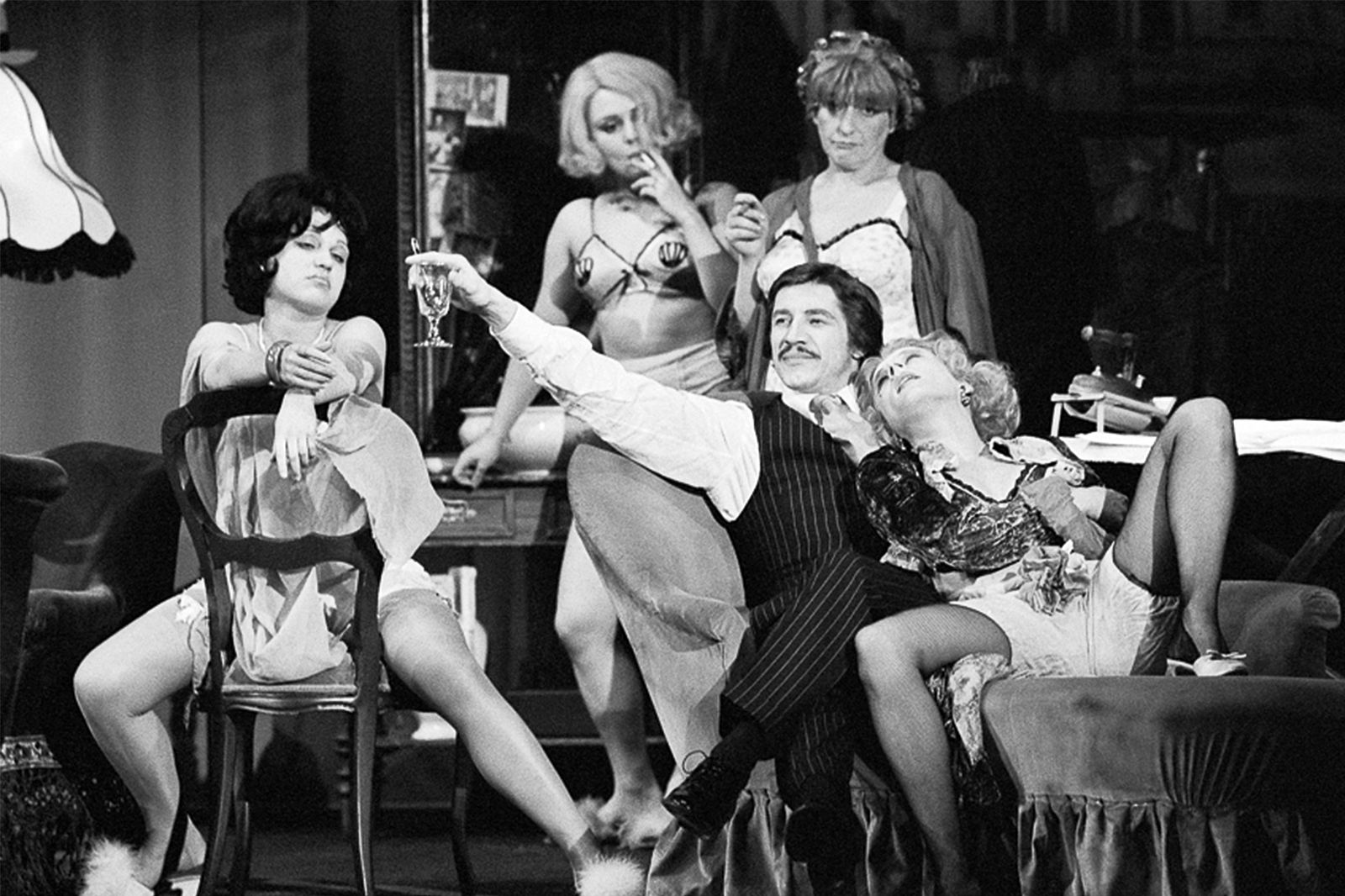
“Was ihr wollt” (2000/01), by William Shakespeare, directed by Christoph Marthaler
© Leonard Zubler

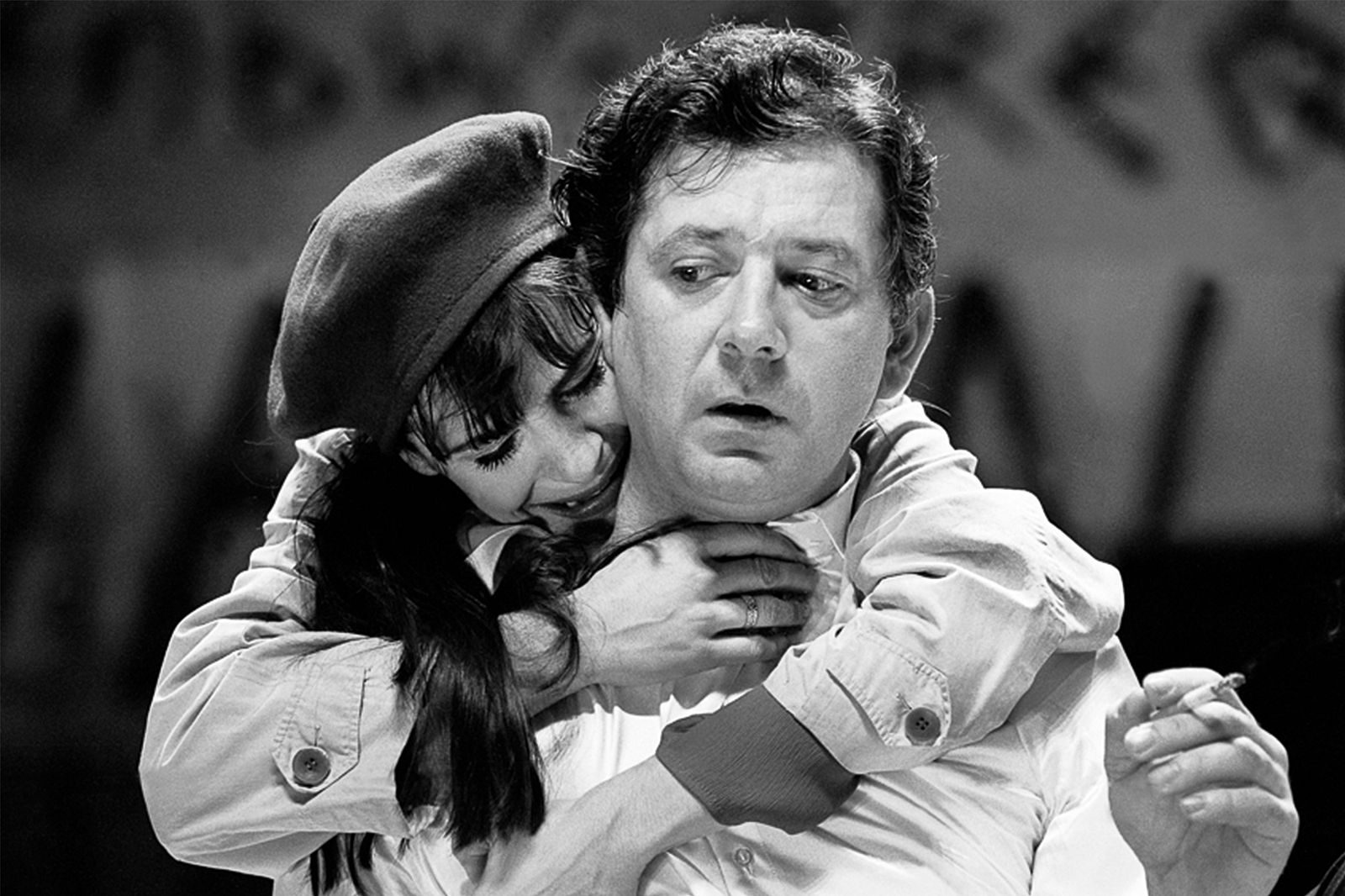
“Amadeus” (1981/82), by Peter Shaffer, directed by August Everding © Leonard Zubler

17.09.2026 THE THREEPENNY OPERA AT SCHAUSPIELHAUS ZÜRICH

The Schauspielhaus Zürich’s photographic archive dates back to the 1938/39 season and preserves a wealth of photographic records documenting productions from decades past. One of the theatre’s defining chroniclers was the recently deceased Leonard Zubler, who photographed life on stage at the Schauspielhaus from the 1960s onwards.

To mark the theatre’s 100th anniversary and the opening of this season with THE THREEPENNY OPERA, we delve into the photographic archive: How has Brecht’s classic been staged at Schauspielhaus Zürich over the decades? What stories lie behind the images? We take a closer look at selected photographs from various productions.

1949/50

“The Threepenny Opera”, Pfauen, 1949/50, directed by Oskar Wälterlin. Anneliese Römer as Polly and Gustav Knuth as Macheath. © Doris Gattiker

For a long time, there was much debate over whether Bertolt Brecht would revise The Threepenny Opera specifically for the Schauspielhaus Zürich after 1945. The production was announced several times, but Brecht’s new version never materialised. For the inventor of “epic theatre”, Zurich was no longer a place where theatre history was being made. His full attention was now focused on East Berlin, where, in November 1949, he founded the Berliner Ensemble together with his wife, the actress Helene Weigel. Yet, “by way of exception”, as he wrote in a letter to dramaturg Kurt Hirschfeld, Brecht allowed the Schauspielhaus to stage the play even in his absence. Artistic director and director Oskar Wälterlin then drew on his existing repertoire: his production of The Threepenny Opera, originally created at Theater Basel in 1929, was brought to the stage again in Zurich, this time under different circumstances.

1972/73

“The Threepenny Opera”, Pfauen, 1972/73, directed by Harry Buckwitz. Christine Müller as Dolly, Angela Weber as Sally, Fred Haltiner as Macheath, Helga Mertens as Betty, and Sibylle Courvoisier as Vixen.*
*Identification not definitive. © Leonard Zubler

When director Harry Buckwitz was appointed the new artistic director of the Schauspielhaus in 1970, it was to be expected that he would bring Brecht with him to Zurich. He had already directed The Threepenny Opera in Frankfurt in 1966 and, with numerous productions of Brecht’s works, had taken a stand against the anti-communist climate prevailing in West Germany at the time. Buckwitz had known Bertolt Brecht personally and had played a decisive role in establishing his work in West Germany despite political attempts to exert influence. In Zurich, Buckwitz was expected to calm the waters after the fierce conflicts between Peter Löffler and the conservative audience. Plenty of music might have seemed the best way to do so—but was a “beggar’s opera” really the right choice? At least Buckwitz could count on an international star-studded cast: Fred Haltiner appeared as Macheath, while the American singer Olive Moorefield played Low-Dive Jenny.

1994/95

“The Threepenny Opera”, Pfauen, 1994/95, directed by Herbert Wernicke.
Desirée Meiser as Polly and André Jung as Macheath. © Leonard Zubler

In the 1994/95 season, during Gerd Leo Kuck’s tenure as artistic director, Herbert Wernicke, a trained opera director, came to the Schauspielhaus to stage an opera that does not want to be one. Wernicke brought Brecht and Weill’s The Threepenny Opera back to Zurich, the city of banks—and with it the bank robber Macheath, played by André Jung. Jung had been appearing on the Pfauen stage since the 1980s, but it was not until Christoph Marthaler’s tenure that he became a member of the Schauspielhaus Zürich ensemble. By 1995, however, The Threepenny Opera, once considered provocative, had lost its power to shock. The Cold War was over, and Brecht had meanwhile become a “classic”. What had once been politically explosive had turned into a popular success: all 49 performances were sold out.

For those who would like to delve even deeper into the photographic history of the Schauspielhaus and the production history of The Threepenny Opera, we warmly invite you to visit our small photo exhibition in the upper foyer of the Pfauen, featuring additional photographs and insights into past productions.

More information about the exhibition “The Threepenny Opera and Schauspielhaus Zürich” can be found here.

10.09.2026 NOT WELCOME

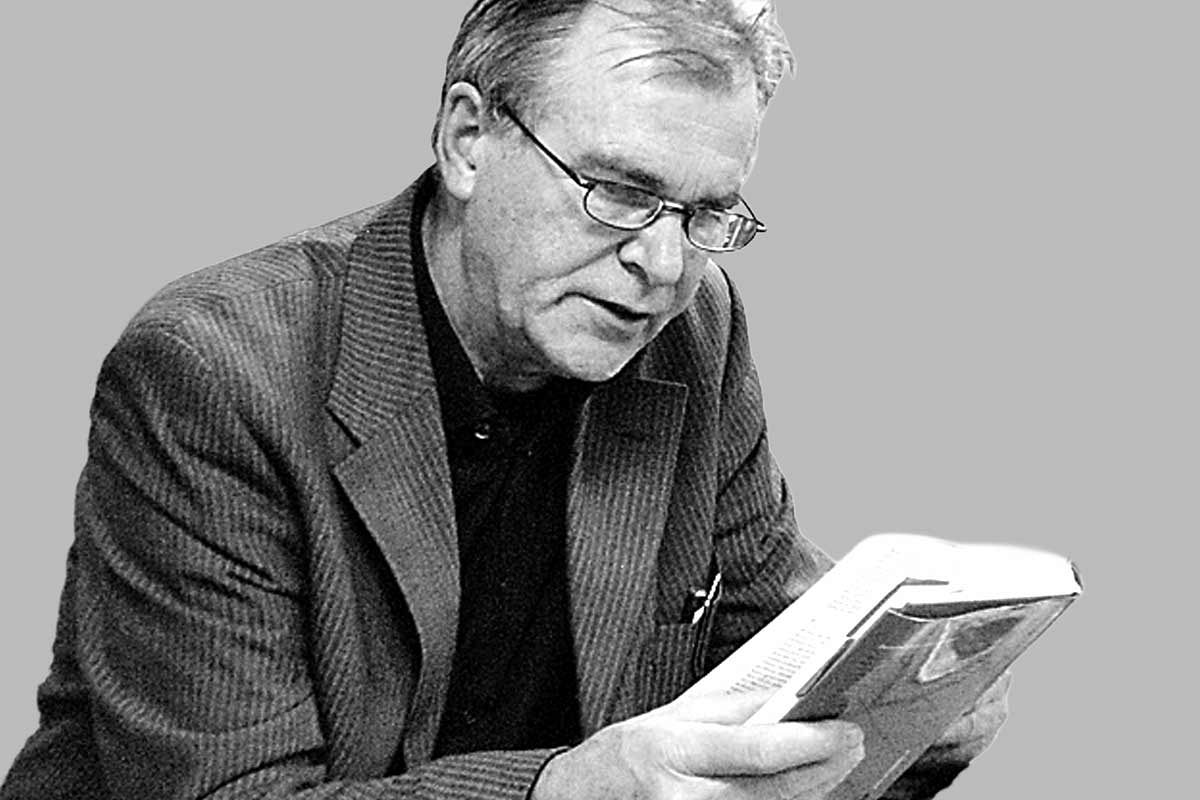
Werner Wüthrich © Johanna Gerber

03.09.2026 THE BUILDING HISTORY OF THE PFAUEN. NO. 1: FROM PUB TO SCHAUSPIELHAUS

Where Rämistrasse meets Heimplatz today, there was still a simple inn called “Zum Pfauen” in 1837. Before long, it was joined by bowling alleys, beer gardens, and a modest hall for choral performances—places of entertainment for the growing community of Hottingen, which at the time was still an independent rural municipality just outside the gates of Zurich. Over the decades, ownership and uses changed repeatedly, until the enterprising innkeeper Heinrich Hürlimann transformed the cluster of small buildings in 1884 by establishing the “Flora-Theater,” its first permanent stage.

The decisive transformation was ultimately carried out by the architects Alfred Chiodera and Theophil Tschudy. In 1888/89, they built the “Volkstheater zum Pfauen,” an imposing historicist complex featuring a domed auditorium with seating for 800 spectators. To this day, it remains one of Zurich’s earliest largely intact examples of comprehensive site development. The first alterations to the stage and its technical equipment followed around 1900, but more ambitious projects could not initially be realised. They all failed either because of the costs involved or because there was insufficient land available behind the stage. It was only in 1923, when the Genossenschaft Pfauen, under the administrative directorship of Ferdinand Rieser, was able to acquire additional surrounding properties, that the way was finally cleared for further development.

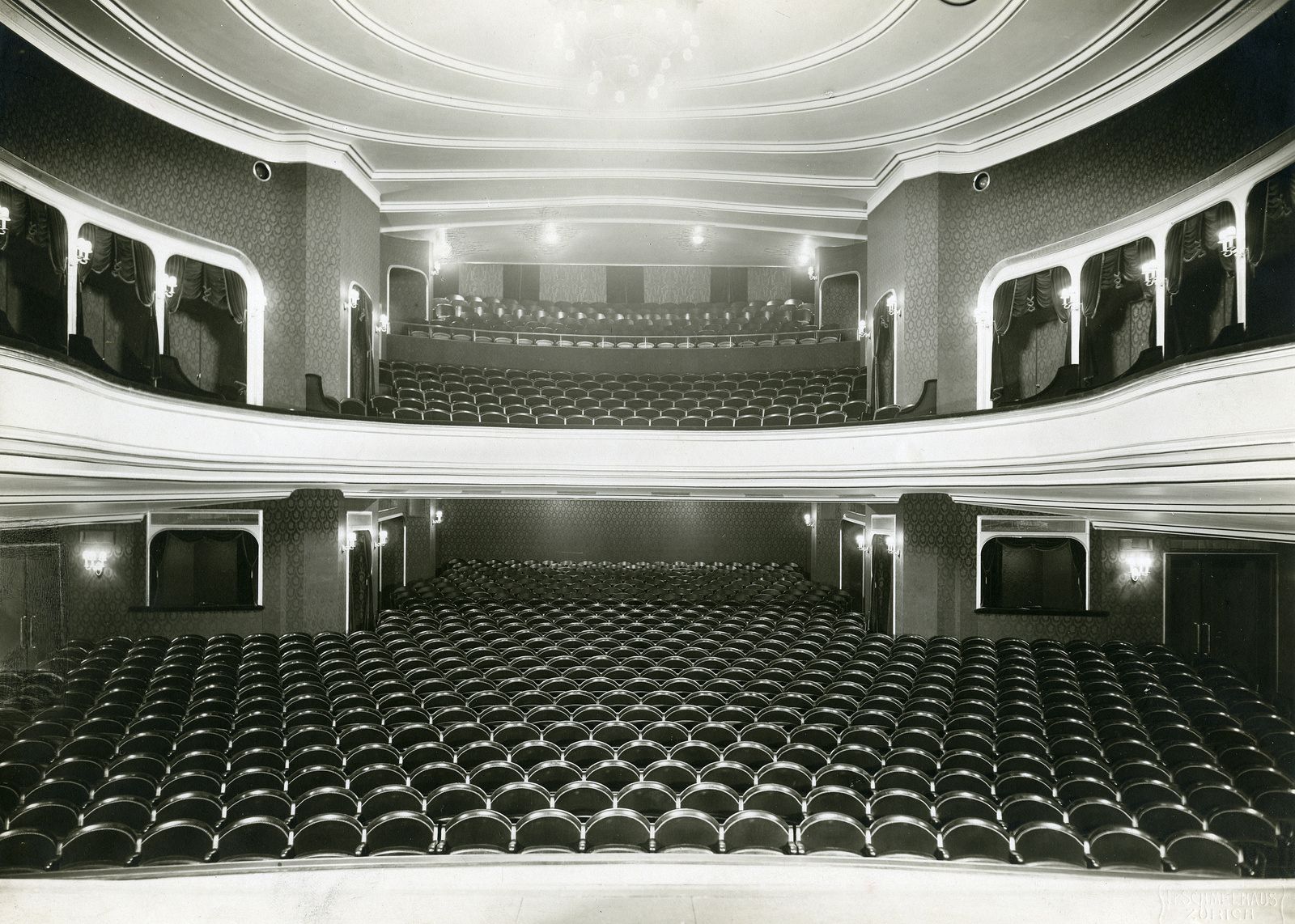
Pfauensaal after 1926 © Baugeschichtliches Archiv, Schmelhaus Franz

When the lease between the Stadttheater (today’s Opera House) and the Pfauen Cooperative expired in 1926 and was not renewed, Ferdinand Rieser took over the running of the theatre himself. Rieser knew that there was one thing he lacked above all: an audience. Until then, various shortcomings of the building had deterred even enthusiastic theatregoers, so the new proprietor had the building thoroughly refurbished.

What architect Otto Pfleghard accomplished in 1925/26, however, was far more than a renovation: it marked the true birth of the Schauspielhaus as we know it today. In less than six months, from April to October 1926, the Pfauen complex underwent extensive construction work. Behind the stage, almost everything that remained from earlier periods disappeared. The stage building doubled in floor area, height, and depth; a cyclorama and a rain-effects system were added; the stage lighting could now be conveniently operated from beside the prompter’s seat; and even the orchestra pit could be enlarged by removing the first row of seats. The Pfauen was now a theatre whose technical facilities could rival those of Europe’s major stages.

In the auditorium, only the gallery balustrade was retained, stripped, however, of all decorative embellishment. Obstructive columns were removed, while the slopes of both the floor and ceiling were systematically aligned towards the stage. Covering over the former courtyard and moving the rear wall further out created additional space and, together with the installation of emergency exits, significantly improved safety.

The result was impressive. Looking back in 1932, the Schweizerische Bauzeitung wrote: “Just as the acoustics had improved, so too had the visual effect of the auditorium; the interior was composed around the time-honoured triad of red, white and a touch of gold, creating an overall impression that achieved a pleasing harmony between a sense of occasion and soothing tranquillity.”

With the 1926 conversion, Ferdinand Rieser had created a theatre that set new standards both technically and in terms of atmosphere, providing the Pfauen with a solid foundation for the decades to come. Yet the architectural history of the Pfauen complex was far from over. Before long, new demands were being placed on both the stage and the building as a whole. In the 1960s, there was even discussion of replacing it with an entirely new building. What became of those plans will be the subject of the next instalment in this series.

27.08.2026 THE RIESERS

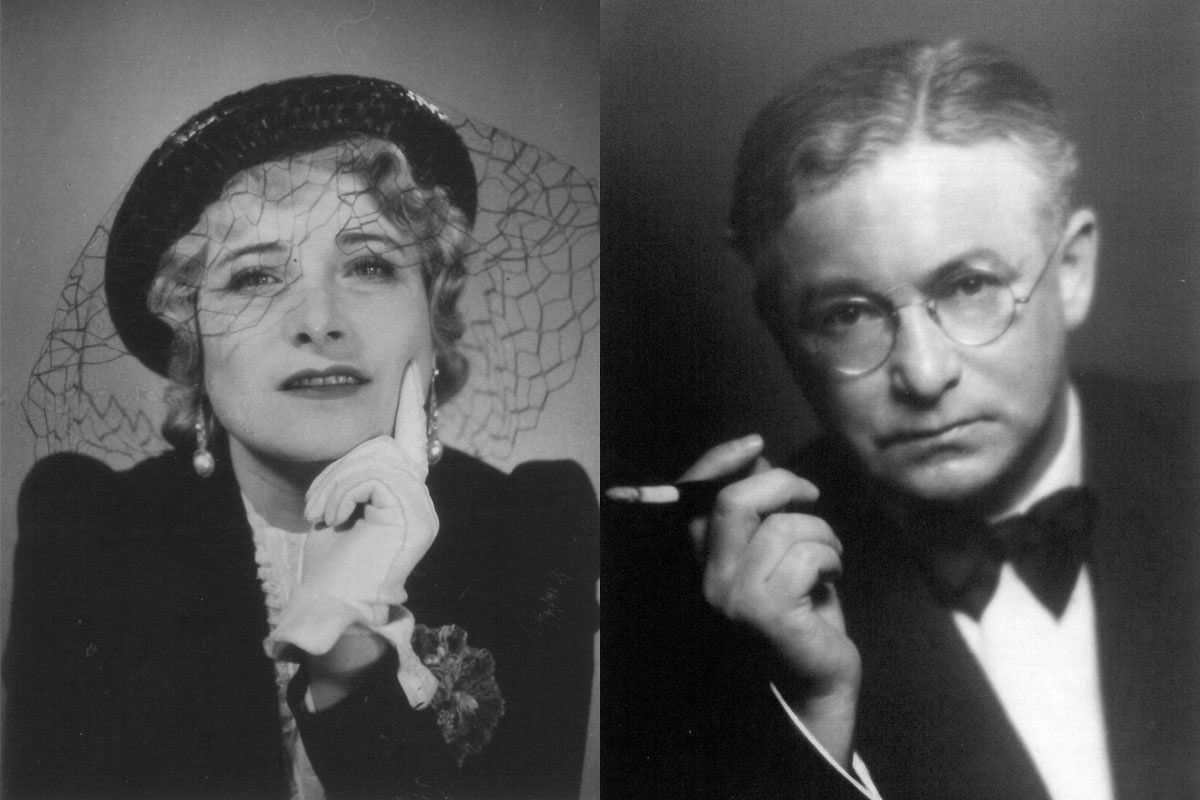
Marianne and Ferdinand Rieser

20.08.2026 100 YEARS OF THE PFAUENBÜHNE: FROM VARIETY THEATRE TO THE WORLD STAGE

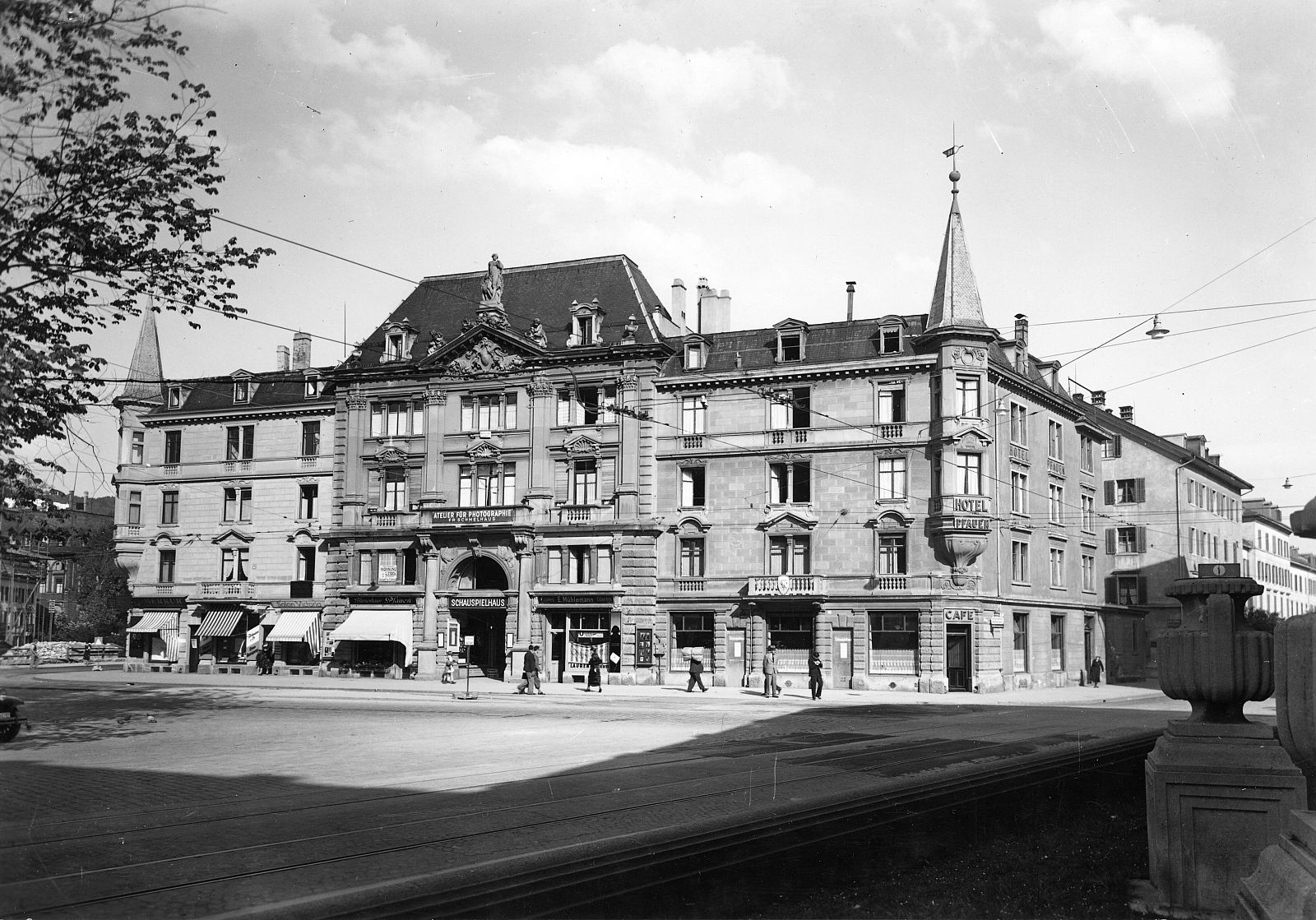
Rämistrasse ca. 1935 © Baugeschichtliches Archiv, Macher Ludwig

Anyone entering the Pfauen auditorium today would hardly imagine that people once went bowling here. At the turn of the twentieth century, the site was home to the “Volkstheater zum Pfauen”, a variety theatre with a beer garden and bowling alley – an entertainment venue that struggled with changing owners and persistent financial difficulties. When Alfred Reucker took over the Stadttheater (today’s Opera House) in 1901, he looked to the Pfauen and found a second venue for the drama section of the Stadttheater, which at the time encompassed opera, ballet and drama. He rented the stage from the Genossenschaft Pfauen and transformed what had been a place of popular entertainment into a serious theatre dedicated to spoken drama. For the first time, the theatre had its own acting ensemble, and the season opened with Goethe’s Die Mitschuldigen (The Accomplices).

Reucker remained artistic director of the Pfauen until 1921. Throughout his tenure, he repeatedly faced the challenge of having to divide his resources among three different artistic disciplines. Caught between opera and ballet, drama in particular suffered from the Stadttheater’s financial difficulties. Although Reucker sought to provide spoken theatre with adequate support, the project came to an end when the finance commission approved the Pfauen for subletting and the Stadttheater withdrew from its less profitable second venue. The new tenant was Franz Wenzler, with Ferdinand Rieser serving as his administrative director. Wenzler already harboured the ambition of giving Zurich an independent theatre devoted to spoken drama. Yet the reorganisation and restructuring of the theatre were hampered by contractual difficulties between tenant and subtenant, between the Stadttheater and the Pfauen theatre, which now called itself the “Schauspielhaus Zürich”. Internal conflicts compounded these problems and soon led Rieser to step down as administrative director. His departure, however, was followed by a different form of involvement: together with his brother, Rieser became the majority shareholder in the cooperative, already paving the way for his comeback.

Then, in 1926, after the lease with the Stadttheater had expired, Ferdinand Rieser, from Riesbach near Zurich, took over the management of the theatre. Rieser now had a free hand in reshaping the building. He enlarged the auditorium and converted the stage into a modern proscenium stage, which remains the heart of the theatre to this day. Above all, under Rieser the theatre at Heimplatz achieved both artistic and financial independence. What had once been a secondary venue serving several artistic disciplines became Zurich’s first independent theatre dedicated to spoken drama – housed in a building whose architecture was thoroughly modern for its time. The foundations had been laid for what would become one of the most important theatres in the German-speaking world.

And today? The bowling alley has long since been forgotten, while the proscenium stage of 1926 is still in place. And the Schauspielhaus has not forgotten its purpose: to create a space in which drama can “develop entirely freely and without constraint, under a leadership that devotes its energies solely to drama”. This was how the board of the Zürcher Theaterverein put it in September 1926, at the opening of the new season. With the 2026/27 season, we celebrate the centenary of this new beginning and look back on the eventful history of this remarkable theatre.